Short Essays
Nov 9, 2023 - Uploaded Feb 21, 2024
It's easy to fall for the trappings of more. For photographers, the drive to show more of a composition and to capture more shots is irresistible at times. I’m guilty of letting this interfere with my photography. By instinct, I desire to have everything recorded. Often I will take several images with different framing and hope that one will stand out when I review them back home. An even worse habit of mine is trying to show too much in a single image and sacrificing everything that made it good in the process. This is how travelling to a preserved patch of old growth forest changed that habit.
In late September, I travelled to the Guelph Arboretum to see the renowned natural beauty within its boundaries. I saw their gardens and untampered forests in nature videos prior to visiting, just to see if visiting would be worth the trip. I was not disappointed by what I saw. As a city dweller, the mystique of a large landscape devoted to natural beauty in all its forms was incredibly mesmerizing. After visiting some of their cultivated gardens, I walked into the Victoria woods, which hasn't faced interference due to its swampy terrain. I remember looking up at the forest's canopy towering more than a hundred feet above and feeling truly astounded at the scale of it all.

The canopy of this old, untouched forest dominates the younger growth
One thing about nature in southwestern Ontario is that it’s largely unremarkable or non-existent. The features of this region that made it so habitable are also ones that make nature photography challenging.
The great lakes region is entirely flatland, with a small escarpment serving as the only point of geographic interest. The vast majority of the area has long been settled, creating urban landscapes connected by open farmland. They’re perfectly fine subjects in their own right, but motels and silos don’t really help when you’re trying to show natural beauty. Most forests have been cleared to make way for homes and roads and those still standing are recovering from centuries of interference. Taking all that into account, my awe at some big trees is hopefully more understandable.

A path running through the heart of the woods, there were still two hours until sunset but the dense brush makes it difficult to tell
At this moment, I encountered a problem that I hadn’t experienced before. Clearly the most compelling thing to me is the sheer scale of the woodland around me. But it becomes incredibly difficult to make out any details as the midground clutter overshadows the background subject if I try to get the canopy and the ground within the frame. Suddenly my nifty nature shot becomes the next trendy camo pattern sweeping Bass Pro Shops nationwide. This isn’t much of an issue in urban photography, as I have more room to move around and capture my subject without adding distractions. The narrow trails I stood on however, were anything but open and spacious. Dead trees littered the ground, with the next generation rising to replace them. Bushes too, lined the trail, obscuring the trunks of the tall maples and pines.
It was almost overwhelming. Having so much around me, and being unable to keep an eye out for bugs and other animals made me feel on edge. I think part of me has a fear of nature, this wasn’t the first time that being in the woods caused me to get stressed and anxious. Perhaps it’s the unpredictability of the environment that causes my fear to build with each step I take deeper, half expecting a snake to slither up my pants and bite my leg. Obviously this doesn’t stop me from going out of my way to walk through forests, but that may be because I always forget the feeling once I’m literally out of the woods. It was as if I was unwanted by the forest and at any moment, a team of squirrels, crows, and bees would strike. I wouldn’t describe myself as claustrophobic, but at times I would hurry through tight sections and this pervasive feeling would taint my experience of the forest.
This incredibly dense yet expansive landscape was awe inspiring to visit, and I’m sure that video could depict it well, but photography doesn’t do it justice. There’s a principle in design called visual weight. If we want to emphasize or draw attention to a specific area, like our subject, it should take up the most space, so it can capture the viewer’s attention first. When I tried to make the height of the canopy my subject, I had to shoot it from so far away that it lost its visual weight. The smaller foreground elements, bushes and trees, took up more and more of the frame until they crowded out the background canopy and became the de facto subject.

This image was taken later in on the Baden Hills, but it demonstrates the phenomenon well. What should you be looking at?
If I sound like I’m condemning the experience, that’s not my intention. I really loved being somewhere that was so similar, yet so different to places I had been to before. And while it wasn’t like I was frolicking through a redwood forest, or some misty mountain trail. The swampy woods inspired awe in their own way. I recall looking at the main murky pond on the site, surrounded by trees and their fallen branches. The branches, living and dead, seemed as though they were threatening to crash upon the pond like waves on a beach.

The kidney-shaped pond looked as though it was eating the forest with these branches falling into it
Not only was it beautiful to visit the forest and bask in its scale, but I learned a lot about shooting in different and especially unfamiliar environments. It's easy to fall for the trappings of more. Trying to capture the entirety of large subjects is a recipe for disappointment and has little artistic merit in the rare case of a successful shot. One hundred foot tall trees can look as though they are half that height, and no one really cares about a tiny tall tree. Scale doesn't always translate well into a 2d medium, and you're often better off finding a different attribute to capture than simply size.
Sometimes less is better, and enough is too much. Keeping compositions simple and paring down the quantity of details can prevent a viewer’s eyes from being overloaded. The busier a shot is, the more difficult it will be to parse what is physically there. Getting in closer can be a good way to reduce those unnecessary details. Creative framing can do the same thing, blocking out the noise with a more easily understood object.

The smooth water of the pond and the open sky by the canopy add much needed negative space, balancing the dense and textured brush
Though it sounds strange, aiming towards the ground more can also improve your images(reword). Shooting this way teaches you to think more about the closer objects that themselves have interest and character. Aiming towards the ground also reduces the exposure's contrast, especially during bright times of the day. Getting increased depth and showing less of an often boring sky can also make images more compelling.

A close up detail helps to highlight the small things that get overlooked
I felt truly diminutive walking through the woods that day, in a way I seldom have before or since. Being in the presence of anything vast usually leaves me with a sense of wonder for the large scale of wherever I am, but this was different entirely. Because the forest not only towered over me, but also crowded into my personal space, I felt like I was simply a speck blowing through this growing and decaying landscape. Maybe it's neither nature, nor the woods that scares me and challenges my photography, but the true wilderness that lies within. The forest ecosystem cares not about me or anything else, it simply grows and dies. Its systems and processes continue while I walk through its interconnected heart.
At the end of it all, I walked out of the woods, and headed home. I took two hundred and fifty photos during that walk, I only kept seventeen and even some of those weren’t good enough to be processed and seen. Snapping indiscriminately, what I ended up taking looked more like a tourist’s photo album, documenting what I had seen as opposed to an artistic endeavour. The next time I visit however, I will hopefully find new and better subjects to capture and keep more of the images I take.
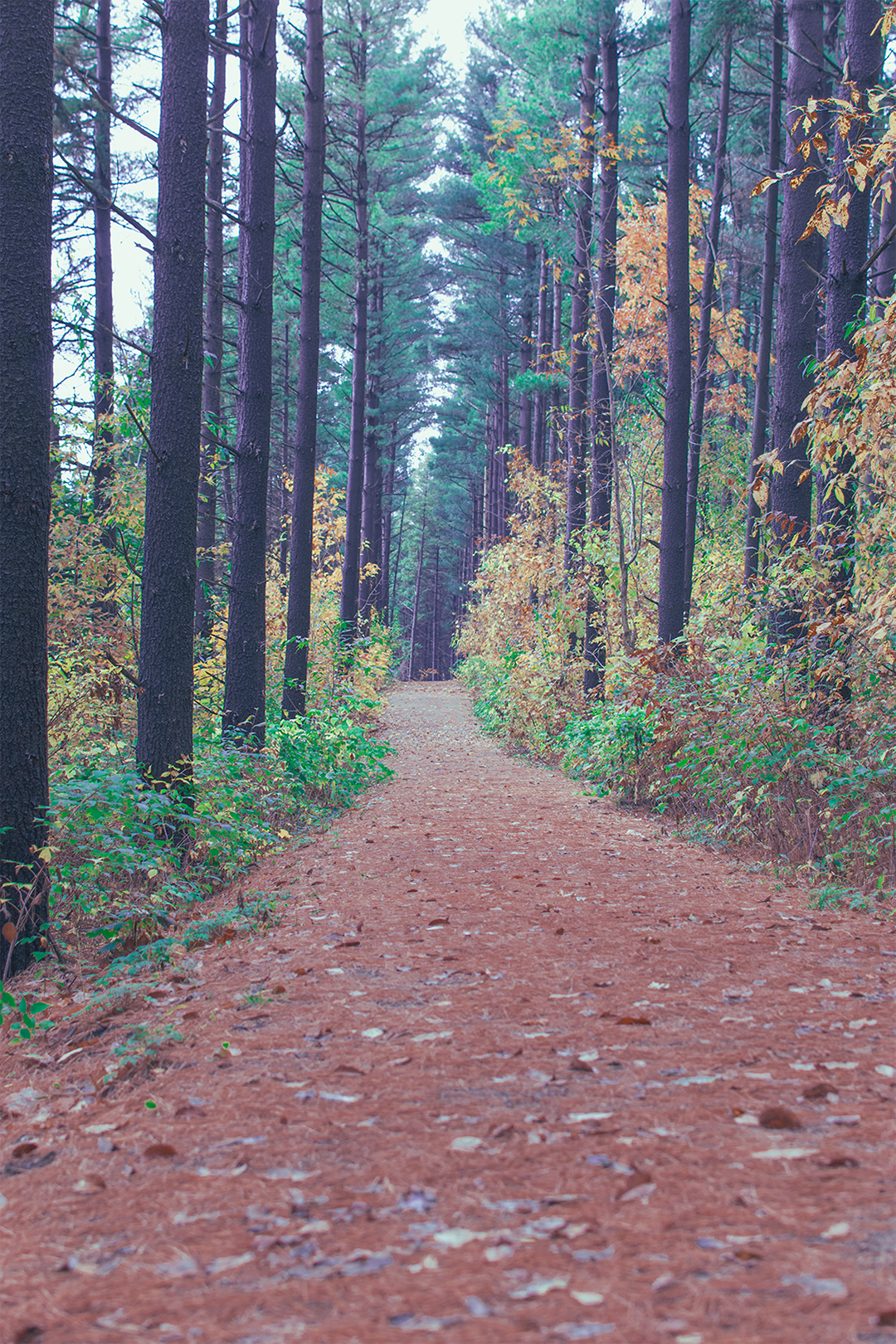
The cleared paths make it easier to capture scale, but following these principles on the Baden Hills allows these tall pines to stand out
Dec 13, 2023: How to Fix Christmas Music
I'm sitting on a mall bench, the chaos of holiday shopping and bargain hunting has put the consumerist hordes around me in a frenzy. A sea of faces wash up and down the poinsettia laden halls, accented with festive-coloured ornamental sticks. Santa walks out of the washroom to begin his Sunday afternoon shift, scratching at some unfinished business on the way out. Waiting for him are throngs of greeting gleeful children and their exhausted parents, eyelids sagging under the debt this time of year incurs. This is surely hell, and this hell is scored with the hallowed echoes of jingling bells and clanging chimes.
For what seems to be an ever-growing number of weeks, Christmas music returns to the air. The yearly scourge to whomever has the misfortune of being able to hear is in full swing: Mariah Carey has been wheeled out of the disney vault she hibernates in from January to November. Record companies and retailers alike are finding new and increasingly cost effective strategies to make George Michael roll in his grave. The debate over whether we should stop listening to ”Baby it’s Cold Outside” rekindles itself like an open fire awaiting chestnuts, and we still end up hearing it everywhere anyway.
I’m sure some people enjoy Christmas music for its cheer and heartwarming nostalgia, and I don’t want to disrupt that innocent joy it sparks within them. I also know of many more who find they become more scrooge-like and curmudgeonly upon hearing their first jingling bell. Given the current state of holiday music, who can blame them? For many, this time of the year is already difficult. Having to keep up with financial struggles, scheduling nightmares, and dealing with terrible weather is a lot on its own. Managing these stressors while a small selection of saccharine songs repeatedly play can make someone feel as though they’re losing their minds.
The first christmas playlist that appears in Spotify’s holiday section contains one hundred songs, which ends up lasting around five hours. This the premiere source for holiday music for many and with Spotify being the largest music platform, you’d expect them to bring their A game. So what kind of music have they selected? Out of those one hundred songs, eighteen of them are duplicates of existing songs on the playlist. The tracks that are original contain entries by Bro Country favourites Dan + Shay, Train, and two songs from Sia. Regardless of your taste in music, I’m sure you can agree that at least one of those shouldn’t be there.
If the world’s biggest music platform can’t find a hundred decent songs for a christmas playlist, there’s something very wrong with the genre. How can we expect radio stations and malls to pump out hour after hour of music when there is such a dearth of playable tunes? They’re scraping the bottom of the barrel by the time 1pm rolls around on November twelfth, the first day in a more than seven week slog of non-stop jingling.
When I was initially writing my points, I said that 1/12th of the year was spent with Christmas music in the air, but in doing that previous calculation, I’ve realized the figure is far higher. Instead of the 8.333% I had assumed, it’s a whopping 13.5%, let’s put that into perspective. If you listened to Christmas music every week for a full waking day, you would feel sick and it wouldn’t be enough. If you listened for another six hours the next day, that still wouldn’t be enough to equate the nearly two months that we spend with sleigh bells and mistletoe against our will. No one with free will would choose to spend that much time hearing songs of Santa and snow. How do we still accept this torment?
I Didn’t always hate Christmas music, there are stories of me as a child singing carols with unbridled enthusiasm. Though it may have only been the “fa la la la la” section of Deck The Halls, there was enough passion for the whole number. But ten months isn’t enough time to recuperate from the festive fatigue, and I grew more discontent with each year. Eventually, I found myself waiting for a flu shot, while some snap-filled Bro Country Christmas track permeated the drug store. At that moment, I seriously considered risking a week of sickness to not hear the 3 minutes that was left in that song. It seems to be a common sentiment that there isn’t enough time to overcome the previous year’s festive exhaustion anymore. I’ve heard complaints about the Christmas season starting earlier each year. And I know of more people who purposely avoid Christmas radio stations than those who listen to them.
So what can be done to fix this situation? Is Christmas music a lost cause? Well… Kinda, yeah. For now at least, the existing catalog of christmas classics is too worn out to be the basis of music after Remembrance Day. Instead we should encourage new holiday songs rather than repeatedly pilfering Irving Berlin’s long-decayed corpse. The preoccupation with Christmas doesn't have to continue either. Have you ever heard a Kwanzaa song? There are whole canons of holiday music waiting to be unlocked.
Christmas music tends to have a laid back, jazzy and classical vibe to it. We can lean into that by playing instrumental jazz in between christmas songs, so those precious few good songs feel fresh for longer. When has anyone heard Vince Guaraldi’s music play and had a problem with it? Regular, relaxing music could also be an option for extending the lifespan of Christmas music. Not every track in a playlist has to concern winter and sleighs. Shouldn’t we aim to calm and soothe people, especially with how hectic and stressful the holidays can be? I don’t think anyone has ever listened to Sia’s “Santa’s Coming For Us” and felt calmed by it.
It seems that the holiday season is inescapable and constantly growing longer. If we aren’t going to limit our exposure to holiday music, the least we can do is make it a more pleasant experience. Maybe that will make weekends at the mall less horrifying, though I think that’s expecting too much. I have created a playlist of my own, that shows how these ideas can come together to improve the holiday listening experience.